
Bethesda Resident Lookup Records
One name alone proves little. In Bethesda, match the record type to the question, then hunt for a second independent identifier before drawing any conclusion. A parcel ties a party to land. A case entry places a person in court. An estate index names a decedent, a personal representative, or an attorney for the proceeding. Voter rolls help only when the exact registration details are already in hand, and each source carries its own date, purpose, and privacy boundary.
| Record | What it can confirm | Where | Access |
|---|---|---|---|
| Parcel and deed record | Account, legal description, party role, recording date, and liber/folio | SDAT, county GIS, and MDLandRec | Public search; image/account rules can apply |
| Court case | Case number, court, dates, party, type, and summary disposition | Maryland Judiciary Case Search | Index online; complete public file through Central Files |
| Estate | Estate number, decedent, representative, attorney, and docket history | Maryland Estate Search | 1998-present index; file from Register of Wills |
| Voter registration | Registration and district information for a known person | Maryland Voter Services | Exact identity and address fields required |
| Vital or public-role record | Eligible family event, license status, or business filing | MDH, MSA, Maryland Labor, and Business Express | Eligibility and source-specific limits apply |
Begin with the sharpest identifier you hold. A property question calls for the address, the GIS parcel, and the deed fields. A probate question needs a name plus county, date, or estate details. Court work leans on a case number. A business filing can confirm a public role. Its listed office or agent address is never proof of a Bethesda home.
Bethesda Court Search Limits
Maryland Judiciary Case Search is a statewide party-name index. It covers Montgomery County Circuit Court, District Court, and the rest of Maryland's courts. Type the last name exactly as filed. For a partial match, enter the first character followed by a percent sign. The first name is optional. Narrow early by court, case type, and date. The system caps a name search at 500 results. It can also time out after two minutes. A broad Bethesda surname is a poor opening move against those limits.
Case Search is an index only. A result may show a case number, city, dates, type, and disposition. Sealed, shielded, or expunged matters stay unavailable. Take that case number to Montgomery Circuit Court Central Files in North Tower Room 1100. The Clerk handles in-person inspection, online copy requests, mail, and a 24-hour drop box. Public kiosks stand in Central Files, the Criminal Department, and the Law Library. Older cases may sit unscanned or transferred. An online gap therefore proves nothing about the file itself.
The Montgomery County inmate-information page shows another limit. The county publishes no online jail roster. It points callers to a 24-hour Inmate Records Section instead. Custody data is a separate, time-sensitive category, not a general measure of Bethesda residence.
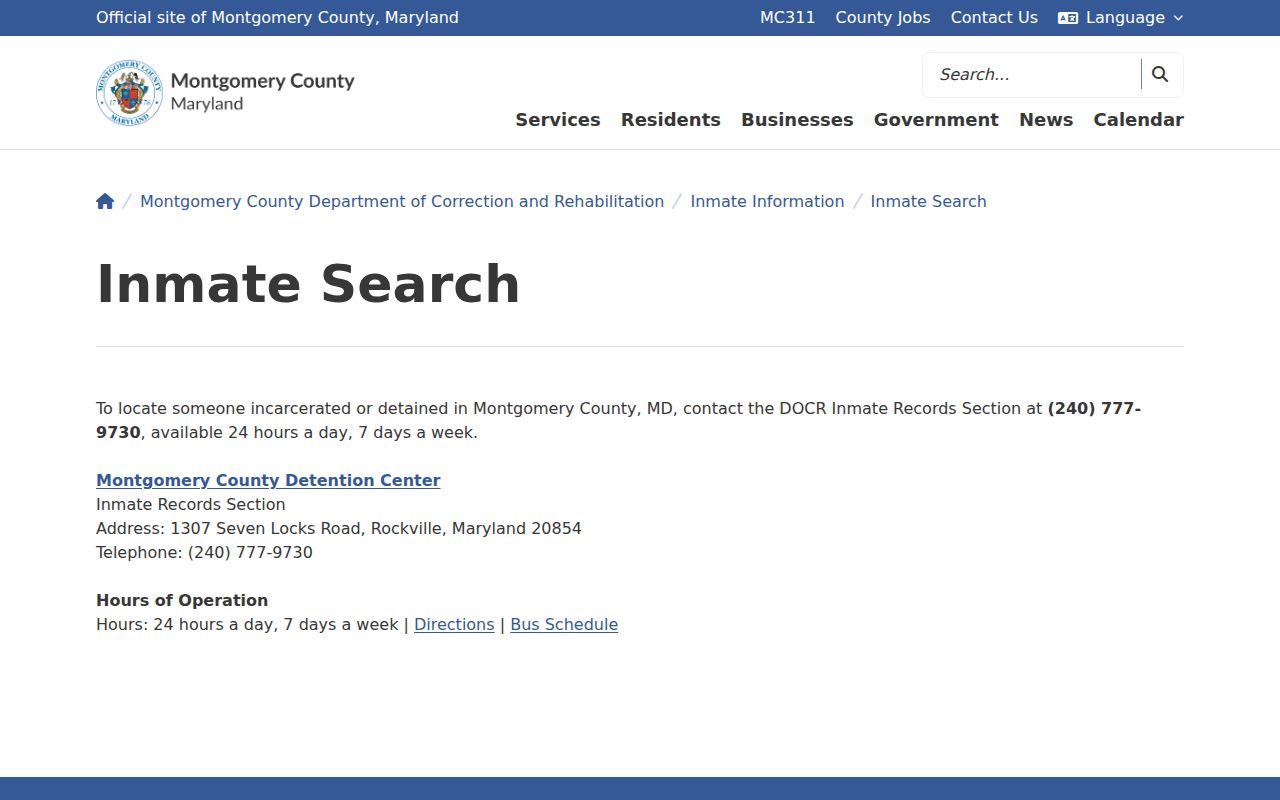
The county notice states the phone fallback plainly. That wording keeps an empty web search from being mistaken for a complete county result.
Note: Central Files strongly prefers a case number, and older files that are unscanned or transferred may need extra handling.
Bethesda Estate Search Trail
Maryland Estate Search is the straight probate route for a decedent or heir trail. The index reaches back to 1998. It updates daily by the end of the business day. Search by decedent name, then add date of death, county, estate number, status, type, personal representative, attorney, alias, or docket history as available. Wildcards help with spelling variations. Results cap at 500 here too, and timeouts happen.
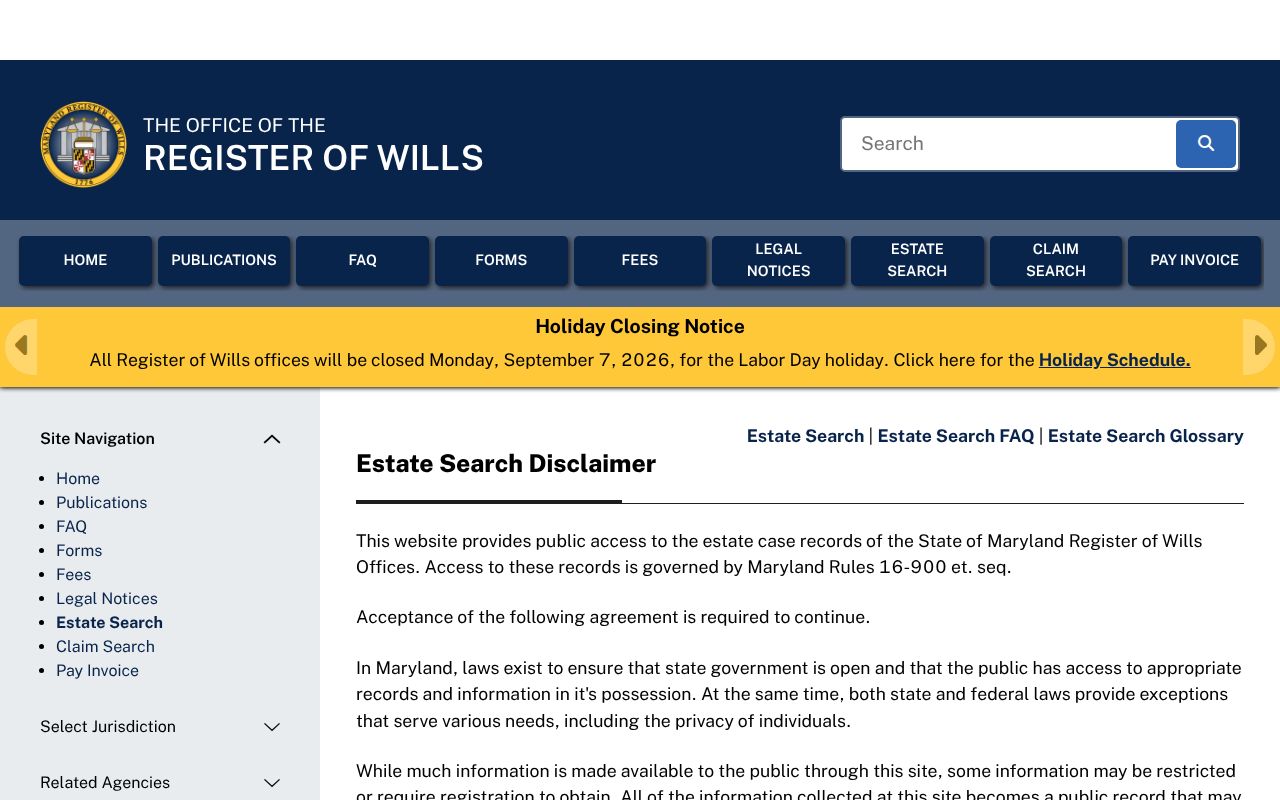
The estate-search screen finds a docket. It also flags the responsible county office. The actual probate papers, though, come from the Montgomery Register of Wills and Orphans' Court rather than from the online summary. Record the estate number before requesting a file. The index can identify people associated with the proceeding, but it does not reproduce every will, petition, address, or supporting paper. That distinction matters when confirming a relationship or a historical Bethesda address.
Bethesda Voter Lookup Fields
Maryland Voter Services checks one known voter. It is not a name-only roster. The form requires a first name, last name, date of birth, five-digit ZIP code, and street number. A middle initial is optional. The registration name must match what was filed. Updates run daily, a new registration can take three weeks to appear, and a prior name or old ZIP sometimes helps for someone who moved.
| Field | Input needed |
|---|---|
| First and last name | Letters and spaces, using the registered form of the name |
| Date of birth | Valid month, day, and year |
| ZIP code | Exactly five digits |
| Street number | The registered number, with letters, numbers, commas, hyphens, or slashes accepted |
The individual voter form is one thing. A full voter-list request is another. State law demands a written application, an oath, a fee, and a permitted electoral use for the full list. A blank response can mean a spelling mismatch, a move, a data lag, or a protected address rather than nonregistration.
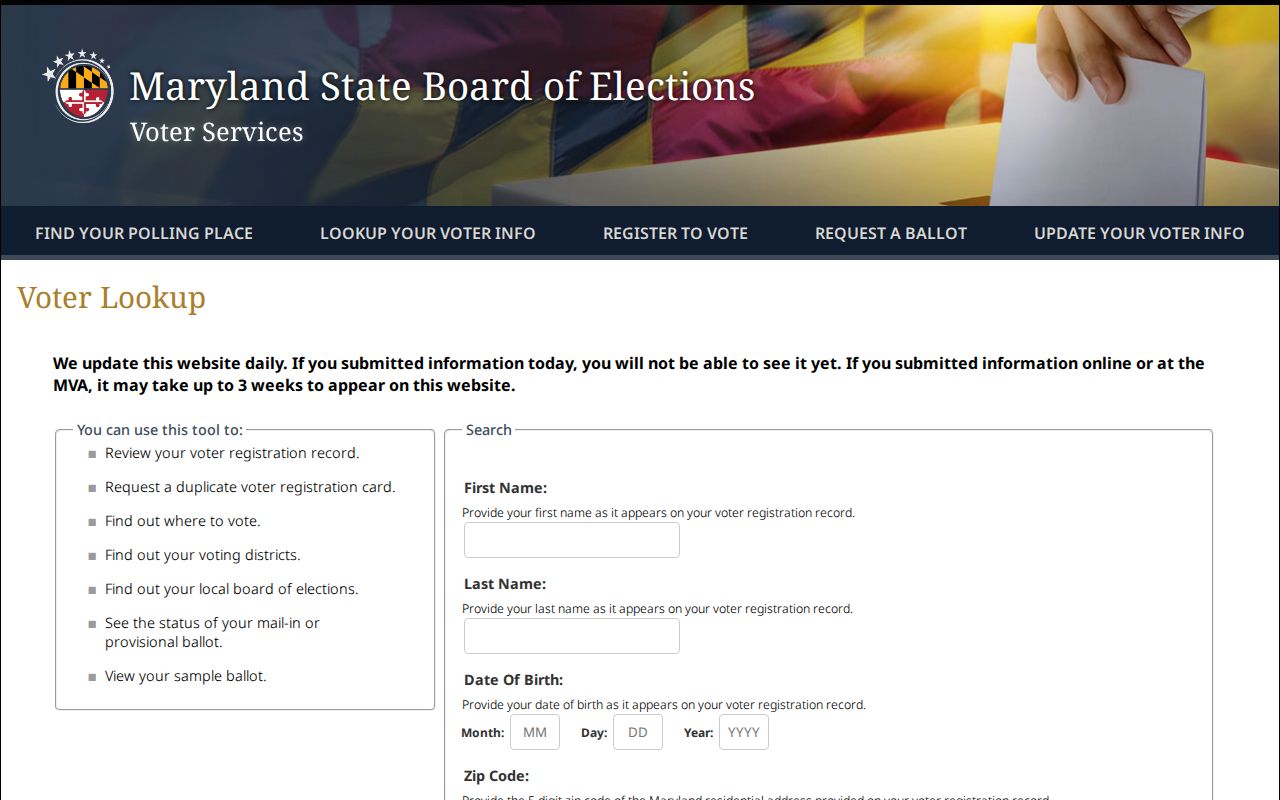
The state form shows its logic plainly. Exact birth date, ZIP, and street number keep a voter check tied to one real person.
Verify Bethesda Resident Records
Each custodian keys its records to its own fields. Trust those identifiers over any blended search result. An owner name sits on a parcel, a case party may list an earlier address, and a voter result is tied to a registration record. Keep the custodian's spelling exactly. Note the date you checked, and lean on the account, case, or estate number whenever the records office supplies one.
- Write down the full name, known variants, approximate age, exact Bethesda address or ZIP, and any case, parcel, or entity number.
- For an address question, use the GIS parcel and SDAT account, then preserve the deed’s legal description and liber/folio rather than relying only on a street number.
- For a court or probate question, search the name with county, court, date, type, or estate fields that narrow same-name results.
- Use voter or vital-record routes only when their required identity information and published access rules fit the question.
- Keep conflicting facts as separate dated records until the custodian file resolves the difference.
- Docket
- A court or estate’s dated list of filings, events, and actions. It locates activity but is not automatically the complete file.
- Index and image
- An index points to a record through names, dates, or numbers. An image is the scanned document and can have separate account, payment, or access rules.
- Certified copy
- A custodian-issued copy bearing the certification required when an official copy, rather than a search result, is needed.
Bethesda Vital Record Routes
Vital records run on eligibility and date rather than broad name searching. Maryland’s Division of Vital Records handles modern certificates. It publishes mail, appointment, local-health, and authorized online routes. Older material stays with the Maryland State Archives. That split matters. Birth certificates are closed for 100 years. Another rule can apply in limited cases. For deaths, MDH covers Maryland deaths from 2012 forward, and the Archives covers the earlier years. Marriage certificates from January 1, 2007 forward and divorce verifications from 1992 forward follow their own state routes. The divorce decree itself stays with the Circuit Court that granted it.
Eligible applicants supply relationship, authorization, identification, application, and fee. A public-records request does not bypass those requirements. For older family research, the Archives’ Montgomery guide maps the historical marriage, birth, and death series, indexes, and microfilm before a copy request.
Note: If county marriage-copy date statements conflict, call the Circuit Court before relying on a cutoff or sending payment.
Public Role Record Limits
Maryland Business Express searches an entity by business name or Department ID. The identifier is the stronger handle. Maryland Labor’s public professional query searches a profession or board using a last name or license data. Both official sources confirm a filing, license number, status, filing history, or stated public role. Save the number and status date. Both outlast a casual name match.
A principal-office or resident-agent address proves a filing. It does not prove anyone lives in Bethesda. UCC filings and county business-license information describe a regulated connection at a stated time only. Treat them that way. If an official register skips the category sought, send a focused request to the responsible county department or through the Maryland Public Information Act rather than guess from a business address.
When Bethesda Results Differ
A no-result path is part of any sound resident lookup. Slow down before concluding a person is absent. Check the county, old street spelling, and name variants. Digitization gaps, login walls, and payment barriers hide records too. Bethesda is an unincorporated community. So a record may sit under Montgomery County or a neighboring postal label. Never build an address from partial matches.
Work the custodian chain in order. Start with the county office, then the Maryland agency. The Maryland State Archives, MCPL, and Montgomery History hold historical material. For a county-held record not posted online, file a focused Montgomery County MPIA request. Name the department, record type, address or parcel if known, date range, and requested format. The request route reaches unposted public records. It cannot open a sealed court matter or waive vital-record eligibility.
Bethesda Lookup Privacy Limits
Protected information must stay protected. Maryland Safe at Home gives participants a substitute address. The actual address can be released only through a permitted court order. Voter confidentiality under Election Law §3-309 separately shields qualifying voter addresses from ordinary public disclosure. Court records may be sealed, shielded, or expunged. Maryland Land Records also offers an Internet masking path. It covers prohibited personal identifiers in recorded documents.
If a record looks masked or missing, ask the custodian. Each office publishes its own confidentiality, correction, sealing, or masking procedure. Never reconstruct a protected address from other sources. Maryland Safe at Home, the State Board of Elections confidentiality process, the court clerk, and the MDLandRec notice each serve a different purpose. Each one covers a different kind of protection.
Lawful use. Use Bethesda records for personal, lawful research and verification. Maryland law prohibits stalking and harassment, and protected addresses must never be pursued, exposed, or used to intimidate anyone.